If you’ve ever stood in a grocery store aisle, staring at a shelf stacked with potato chips, pretzels, granola bars, and mini cookies, you might’ve wondered: how do all those snacks get there so reliably, every single week? As a snack food production line supplier who’s walked alongside manufacturers for nearly two decades, I can tell you the answer isn’t magic—it’s math, engineering, and a little bit of hard-won industry data. The capacity of a typical snack production line varies, but it’s not just a random number; it’s tailored to the type of snack, the equipment’s age, and the manufacturer’s needs. Let’s break this down, straight from the factory floor. Snack Food Production Line
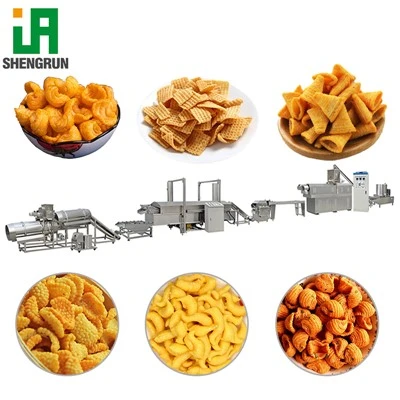
First, let’s define what we mean by a “typical” snack production line, because that’s where most people get stuck. A line isn’t just one giant machine—it’s a sequence of interconnected pieces: mixing bowls, extruders, fryers, ovens, seasoning tumblers, and packaging stations. Each segment has its own limits, and the entire line’s capacity is capped by the slowest part, a concept we call bottlenecking in manufacturing. For most mid-sized snack operations (think regional brands moving 5,000 to 20,000 pounds of product a day, or small national brands), we design lines that hit a sweet spot of 1,000 to 10,000 pounds per hour, depending on the snack type. But that’s a broad range—let’s dive into specific examples to make it real.
Take potato chips, the best-selling snack in the U.S. For a standard kettle chip or ridged chip line, which is one of the most common snack lines out there, the baseline capacity is about 1,500 to 3,000 pounds per hour. I recently worked with a craft chip maker in Ohio who upgraded their 10-year-old line last year; they were cranking out 1,200 pounds an hour before, but swapping out their old batch fryer for a continuous fryer upped their output to 2,700 pounds an hour. The difference? Continuous fryers can process sliced potatoes nonstop, rather than waiting for a batch to cook, so they don’t waste time loading and unloading. That’s a key upgrade point we highlight for clients: older lines often have bottlenecks in pre-processing or cooking, so capacity jumps come from fixing those spots, not just buying a bigger oven.
Pretzels and baked snacks, like tortilla chips or rice cakes, follow a slightly different formula. These are baked instead of fried, so their lines rely more on dough preparation and oven speed. A standard soft pretzel line might run 1,200 to 2,500 pounds an hour, while a hard pretzel line hits 2,000 to 4,000 pounds an hour. Tortilla chip lines, which combine dough pressing, cutting, and toasting, usually land at 2,500 to 3,500 pounds an hour. Last quarter, a Texas-based tortilla brand came to us because their old line was falling short of demand—they were only making 1,800 pounds an hour, leading to stockouts at local grocery chains. We reconfigured their dough feed system and replaced their old conveyor oven with a multi-zone oven, which let them adjust heat and speed based on the chip’s thickness. Now they’re at 3,200 pounds an hour, and they haven’t had a stockout in six months.
Then there are the snack bars—granola bars, protein bars, and cereal bars. These have a different workflow: mixing the binding agent (usually honey or syrup), combining with grains or nuts, pressing into a slab, cutting into bars, and packaging. A typical bar production line’s capacity is 1,000 to 4,500 pounds an hour. The wide range here comes from bar size and complexity: a mini cereal bar (1 ounce) will run faster than a dense 2-ounce protein bar with add-ins like dried fruit or chocolate chips. I worked with a Canadian protein bar brand a couple years ago that specialized in 1.5-ounce bars; their line ran at 4,200 pounds an hour, which let them supply 10 million bars a month to gyms and health food stores. If they had switched to a 2-ounce bar, that same line would drop to around 3,000 pounds an hour, all because the cutting and packaging stations could only process so many units per minute.
Now, let’s talk about what happens when a manufacturer needs higher capacity—say, a national brand that wants to move 10,000 pounds an hour or more. Those lines aren’t the “typical” ones I mentioned earlier; they’re high-capacity lines built for large-scale distribution, often running 24 hours a day, 6 days a week. For example, a major national potato chip brand uses a line that runs 8,000 to 12,000 pounds an hour, with 40-foot continuous fryers and high-speed packaging machines that can seal 100+ bags per minute. But even those lines have their limits—we recently had to tell a client that their request for a 15,000-pound-an-hour chip line wasn’t feasible with standard potato prep equipment, because slicing and washing potatoes can’t keep up that pace without causing waste. We worked with their team to adjust their forecast, and they went with a 10,000-pound line that still met their needs, without the extra cost of overcapacity.
It’s important to note that capacity isn’t just about speed—it’s about efficiency and product consistency, two things snack brands can’t compromise on. A line that runs 5,000 pounds an hour but has a 10% waste rate from broken chips or mis-cut bars is less valuable than a line that runs 4,000 pounds an hour with a 1% waste rate. That’s why when we work with clients, we don’t just quote a number—we walk them through their specific product, their current downtime, their waste rates, and their long-term demand. A small craft brand might not need a 10,000-pound line; they might only need 1,500 pounds an hour to start, so they can avoid tying up cash in equipment they don’t need. Last year, we helped a startup cookie brand in Portland build a 1,200-pound-an-hour line, which was perfect for their first two years of operation. Now, as they expand, they’re adding a second shift and will upgrade to a 2,500-pound line next year.
Another common question I get: does the type of packaging affect line capacity? Absolutely. If you’re packaging into large bulk bags for food service, a line can run faster than if you’re packaging into individual 1-ounce bags for retail. For example, a bulk pretzel line might run 3,500 pounds an hour, but switch to individual 1-ounce bags, and that same line will drop to 2,000 pounds an hour because the packaging machine has to seal and label each small bag. We always factor in packaging type when designing a line—we had one client who switched from bulk to retail packaging mid-year, and we modified their packaging station to handle smaller bags, which let them keep producing 2,800 pounds an hour instead of slowing down.
Now, let’s get into the real-world numbers that matter most to you, the manufacturer or brand owner. If you’re looking at a new line, here’s a quick cheat sheet of typical capacities, based on snack type and line size:
- Small craft line (1 shift, 5 days a week): 500–1,500 pounds per hour
- Mid-sized regional line (1–2 shifts, 6 days a week): 1,500–5,000 pounds per hour
- Large national line (2–3 shifts, 7 days a week): 5,000–12,000 pounds per hour
But wait—what about variables that can change these numbers? Things like product mix, for one. If a line runs multiple snack types in a day, switching from chips to pretzels to bars, there’s downtime for cleaning and changing molds, which can lower average daily capacity by 10–15%. We always advise clients who run mixed lines to build in that downtime when calculating their needs. Maintenance also plays a role: a line that’s well-maintained, with regular checks and replacement parts, will run at 90–95% of its maximum capacity, while a neglected line might only hit 70–75%. That’s why we include ongoing maintenance support with every line we sell—something that’s saved our clients thousands in lost production over the years.
I’ve seen a lot of manufacturers make the mistake of buying the “biggest line possible” to avoid growth issues later, but more often than not, that leads to unnecessary costs. A friend of mine who runs a mid-sized snack brand told me a few years ago that he spent $200,000 on a 10,000-pound line when he only needed 3,000 pounds an hour. He ran it at 30% capacity for two years before he hit the demand that justified the size, and he could’ve used that extra $200k for marketing or product development. That’s why we take the time to do a needs assessment first: we ask about their current monthly production, their growth plans for the next 3–5 years, their product SKUs, and their budget, so we can design a line that’s just right for them.
Let’s also talk about recent changes that have shifted snack line capacity in the last five years. Plant-based snacks, which have exploded in popularity, often require different processing than traditional snacks—like extruded veggie puffs or baked vegetable chips. Those lines typically run at 1,800–3,000 pounds an hour, slightly lower than potato chip lines, because the vegetables have to be washed, peeled, and processed before they go into the extruder. We’ve had to adapt our equipment to handle delicate plant-based ingredients, which has actually increased capacity for those lines by about 10% compared to what we offered five years ago, thanks to better feeding systems and precision cutting tools.
Another trend: automation. Smaller brands are adding more automation to their lines, which can boost capacity without hiring more staff. A line that used to need 5 workers to handle mixing, cutting, and packaging can now run with 2 workers, thanks to automated feeders and robotic packaging stations. That not only cuts labor costs but also reduces human error, which lowers waste. We recently installed an automated bar line for a brand in Florida; they went from 1,200 pounds an hour with 4 workers to 2,800 pounds an hour with 2 workers, and their waste dropped from 8% to 2%. It was a win-win for them—higher output, lower costs, better product consistency.

At the end of the day, the capacity of a typical snack food production line isn’t a fixed number—it’s a customized solution for each brand’s needs. Whether you’re a startup making 1,000 pounds of mini cookies an hour or a national brand making 10,000 pounds of tortilla chips an hour, the right line will balance speed, efficiency, and product quality. If you’re looking to upgrade your current line, launch a new product, or scale your production, we can help you design a line that fits your goals. Get in touch to discuss your specific needs, and we’ll walk through the right capacity and equipment for your operation.
Fish Feed Production Line For further reading on snack production line capacity and manufacturing efficiency:
- Snack Food Association. (2021). “Modern Production Lines: Capacity, Efficiency, and Quality Standards for Snack Manufacturers.” Industry Report.
- Food and Drug Administration. (2020). “Current Good Manufacturing Practices for Snack Food Processing.” Federal Register Guidance Document.
- Machinery Dealers National Association. (2022). “Optimizing Production Line Capacity: A Guide for Food Manufacturers.” Technical Bulletin.
- International Society of Automation. (2021). “Automation Impact on Snack Food Line Throughput and Waste Reduction.” Industry Journal.
Jinan Shengrun Machinery Co., Ltd.
We are one of the most professional snack food production line manufacturers and suppliers in China, featured by quality products and good price. Please rest assured to buy durable snack food production line for sale here from our factory. Contact us for more details.
Address: 1817 Rongce Center, No.3179 Qilu Avenue, Xingfu Street, Huaiyin District, Jinan City, Shandong Province
E-mail: sales@foodgm.cn
WebSite: https://www.food-gm.com/
