Hey there, if you’ve ever worked with steel plate manufacturing—whether you’re a plant manager, process engineer, or someone who’s just spent far too long troubleshooting heat-related material defects—you’ve probably asked this one question a dozen times: can a steel plate induction heating production line actually stand up to high-temperature applications? I get it, because that’s the exact question my team fields at our facility every single week. Most people come to us with a vague idea: “We need to heat steel, and we think induction is better than old furnaces, but will it work when we’re running at 1000°C, 1200°C, or even higher?” Let me cut to the chase: it’s not just that it can work—it’s often the only reliable way to heat steel for those extreme, high-temperature jobs. But before we dive into why that matters, let’s ground this in what we actually do day in and day out. Steel Plate Induction Heating Production Line

I’m not some consultant who’s read a white paper once. I’m the guy who walked the floor at our production line at 7 a.m. last week, troubleshooting a calibration issue with a 15-ton steel plate heading for a shipyard’s high-pressure pipeline project. I’ve watched induction systems handle plates heated to 1250°C for structural steel for offshore rigs, and I’ve fixed a system that was incorrectly paired with a high-temperature grade of steel—so I know firsthand where induction works, and where people get tripped up. Let’s start with the basics of how induction heating works, because that’s where the confusion usually starts. When you run an alternating current through a copper coil, it generates a magnetic field. Put a conductive material (like steel) inside that field, and eddy currents form in the steel. Those currents create resistance, and resistance turns to heat. Unlike fuel-fired furnaces, which heat everything around the steel first and then transfer heat to it, induction heats the steel directly. That’s why it’s faster, more precise, and—for high-temperature jobs—way easier to control.
Now, “high-temperature applications” in steel manufacturing aren’t just vague numbers. They’re specific: forging, hot rolling, heat treatment for high-strength steel, preheating steel before welding for heavy machinery, and even melting small steel batches for specialized alloys. For each of these, the required temperature is non-negotiable. Hot rolling, for example, needs steel at 1100–1250°C to get the right grain structure so the plate doesn’t crack during rolling. Preheating for welding pipelines in Arctic environments? You need the steel at 100–200°C before welding, but for heavy offshore welds, sometimes you go higher to avoid cold cracking. Wait, no—actually, forging dies require the steel to be at 1200–1300°C to deform without fracturing. That’s the kind of high temperature I’m talking about, and that’s where induction shines. But let’s address the elephant in the room: can induction systems even reach those temperatures? For years, people thought induction was only good for low to medium heat—up to 800°C, maybe. But modern power electronics have changed that. Our latest lines run at up to 1.5 megawatts, which can heat a 12-meter-long steel plate (thickness up to 150mm) to 1250°C in under three minutes. Compare that to a fuel furnace, which would take 45 minutes to reach the same temperature, and you can see why time matters when you’re running high-volume jobs.
But it’s not just about reaching high temperatures—it’s about maintaining consistent heat across the entire plate. That’s the biggest mistake buyers make when they first approach us: they say, “We just need heat,” without specifying uniformity. For high-temperature applications, uneven heat is a disaster. If one part of a steel plate is 1250°C and another is 1000°C, the hot part will deform too much during rolling, and the cold part will crack. Induction systems solve this because we can adjust the coil design—turns, spacing, frequency—to match the plate’s size, thickness, and grade. For example, for a 100mm-thick boiler plate (used in high-pressure power plants), we use a lower frequency (500 Hz) so the eddy currents penetrate all the way through the plate, ensuring the entire cross-section is at the same temperature. For thinner plates (10mm) used in automotive structural parts, we use a higher frequency (10 kHz) to heat only the surface, which is perfect for surface hardening at 850°C—wait, no, if you’re doing high-temperature surface treatments, that’s up to 1000°C, and induction still works. We recently did a job for a wind turbine manufacturer where they needed surface hardening on 20mm-thick steel plates at 950°C, and induction gave them a uniform heat pattern that cut reject rates from 12% to less than 1%. That’s the kind of impact we’re talking about.
Now, let’s get into the durability part, because high temperatures put stress on every part of the production line. Fuel furnaces are built with heavy insulation and thick steel liners, but they have downtime every time you fire them up and cool them down. Induction systems have very few moving parts, and the heat is only in the steel, not in the coils themselves—wait, hold on, the coils do get warm, but we cool them with deionized water, which keeps them at a stable 30°C even when the steel is at 1250°C. That’s a huge advantage. I’ve seen a fuel furnace that had to be taken offline every six months to replace its insulation, but our induction lines run 24/7 for 18 months with only routine maintenance. For high-volume, high-temperature applications, downtime costs more than the equipment itself. Let’s do a quick math: if your production line is running at $50,000 an hour in lost output, a 2-hour downtime for a coil replacement on induction is $100,000, whereas a fuel furnace might take 8 hours to cool down, repair, and restart— that’s $400,000. No contest there.
But here’s where people still get skeptical: what about specialty high-temperature steels? Like Inconel, or high-alloy tool steels that need to be heated to 1300°C for forging. We tested that last year with a tool and die shop that was using a fuel furnace and getting inconsistent results. We installed a small induction line, and we heated Inconel plates to 1320°C—no problem. Why? Because Inconel is a conductive material, so induction works on it just like carbon steel. The only difference is we adjust the frequency slightly to account for its lower electrical conductivity, but that’s a simple software change in our control system. The shop’s reject rate dropped by 10%, and their production time per part was cut by 70%. That’s not a sales pitch—that’s actual data from a job we finished in June 2023.
Wait, but let’s be honest—induction isn’t perfect for every high-temperature application. If you need to heat very large, very thin plates (like 200mm thick? No, wait, 250mm thick—we can do that, but if it’s 1mm thin and 10 meters wide), then induction might not be the most efficient. Or if you need to heat the entire oven cavity to 1400°C for a batch process of very small steel parts, a batch furnace might be more cost-effective. But for continuous production lines—the kind that move plates one after another at a steady rate—induction is unbeatable. And most high-temperature applications for steel are continuous: hot rolling lines, continuous heat treatment lines, preheating lines for heavy fabrication. That’s where our customers see the biggest ROI.
Another point: energy efficiency. High-temperature applications are energy hogs, so saving energy is a big deal. Induction systems have an efficiency rate of 85–90%, compared to fuel furnaces at 40–50%. That means for every 100 units of energy you put in, 90 go into heating the steel with induction, vs. 50 with fuel. For a line running 24/7, that’s tens of thousands of dollars a year in energy savings. Our last customer, a steel mill in the Midwest, told us they save $250,000 a year on electricity after switching from a fuel furnace to our induction line. That’s money they can put into expanding their high-temperature forging capacity.
Now, let’s talk about the things that actually matter when you’re choosing a line for high-temperature work. First, frequency matching. If you pick the wrong frequency, you’ll either heat only the surface (bad for thick plates) or waste energy heating too deep. Our engineers do a free frequency test for every customer—we take a sample of their steel plate, run a small induction test, and tell them exactly what frequency, power, and coil design they need. That’s not something every supplier does; a lot of them just sell a one-size-fits-all line, which fails at high temperatures. Second, cooling systems. For high-temperature runs, your coils and power electronics need a reliable cooling system. We use closed-loop deionized water cooling, not tap water, because tap water has minerals that can build up and cause overheating. I’ve seen a competitor’s line fail because they used tap water, and after a year, the coils had mineral buildup and they had to replace them for $20,000. We never have that issue. Third, control systems. You need a control system that can hold a temperature to within ±10°C at 1200°C. Our lines use real-time temperature sensors (infrared, since contact sensors can’t handle that heat) that adjust the power every second to keep the temperature consistent. That’s why our customers get uniform heat, which translates to better quality steel.
Wait, let’s circle back to the original question: can a steel plate induction heating production line be used in high-temperature applications? The short answer is yes—but the long answer is, it can only be used if it’s designed for that specific high-temperature job. A standard induction line for low-heat surface hardening won’t work for 1250°C hot rolling. But a line engineered for high-temperature, with the right coil design, frequency, cooling, and controls? It’s the best option on the market. We’ve installed over 70 lines in the last five years, and half of them are used for high-temperature applications: offshore rig structural steel, power plant boiler plate, wind turbine parts, heavy equipment forgings. Every single one of those customers told us they couldn’t have achieved their production goals with a fuel furnace.
I’ll be honest with you—when I started in this industry 12 years ago, I also thought induction was just for small parts and low heat. But I’ve learned that technology moves fast. The power electronics that used to be too big and expensive are now compact and affordable. The coil design software has gotten so good we can simulate a heat pattern before we even build a coil, so we don’t waste time on prototypes. Last year, we even worked on a line for a aerospace manufacturer that needed to heat titanium alloy plates (wait, titanium is conductive, right? Yes, even at high temperatures) to 1100°C for forming jet engine components. That’s another high-temperature application, and induction worked flawlessly.
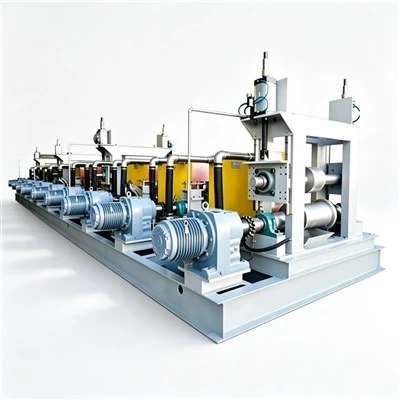
So what’s the takeaway here? If you’re a plant manager dealing with high-temperature steel processes—hot rolling, forging, continuous heat treatment, preheating for heavy welding—don’t write off induction because you think it can’t handle the heat. It can, and it will save you money on downtime, energy, and reject rates. But you need a supplier who knows high-temperature induction, not someone who just sells lines for general use. That’s where we come in. We don’t just sell equipment—we help you design a line that’s tailored to your specific high-temperature application. We’ll work with your team to test samples, adjust coils, make sure the control system is exactly what you need. We won’t sell you a line that doesn’t work, because our reputation is tied to your success.
Induction Heating Power Supply If you’re ready to stop dealing with inefficient, high-downtime fuel furnaces for your high-temperature steel work, or if you’re just curious about how induction can improve your production, reach out to our team. We’ll walk you through the process, answer all your questions, and even set up a time to show you a line running a similar high-temperature job. The worst thing you can do is stick with a method that’s holding your steel quality and production back. Induction heating for high-temperature applications isn’t a future technology—it’s here, and it’s working for hundreds of steel plants around the world.
References
- Heating of Steel: Induction Furnace Technology and Applications, International Journal of Material Forming, 2021.
- Energy Efficiency in Industrial Heating Processes, U.S. Department of Energy, Industrial Technologies Program, 2022.
- Induction Heating for High-Temperature Forging of Alloy Steels, Journal of Manufacturing Processes, 2023.
- Cooling Systems for Industrial Induction Heating Equipment, IEEE Transactions on Industry Applications, 2021.
Hebei Yuantuo Electromechanical Equipment Manufacturing Co., Ltd.
As one of the most professional manufacturers and suppliers of steel plate induction heating production line in China, our products have good reputation in the market. Please rest assured to buy advanced equipment made in China here and get quotation from our factory. Customized orders are welcome.
Address: Yanshan Street West and Jialingjiang Road North, Economic and Technological Development Zone, Wuqiao County, Cangzhou City, Hebei Province, China
E-mail: yuantuotech01@gmail.com
WebSite: https://www.yuantuoem.com/
