If you’ve ever stood next to a high-end precision surface grinder in action—whether in a tool room, aerospace shop, or medical device factory—you might’ve noticed a quiet, almost invisible system working behind the scenes that’s responsible for every smooth, perfect cut: the servo system. As someone who’s spent over a decade selling and troubleshooting these grinders, I can tell you most buyers initially fixate on the grinding wheel, the workholding, or the granite base, but once they run a job that demands ±0.0001mm tolerances, they quickly learn the servo system is the unsung hero that makes all the difference between a parts run that passes first article inspection and one that gets sent back for rework. Precision Surface Grinder

Let’s start with what a servo system actually does in a surface grinder, because it’s not just “moving parts” like a basic motor. A surface grinder has three main linear axes: X (the horizontal cross travel that moves the table with the workpiece), Y (the vertical Z-axis? Wait no, let me get that right—standard surface grinder axes are X: longitudinal table travel, Y: horizontal cross travel, and Z: vertical quill travel that lowers the grinding wheel to feed into the workpiece. The servo system controls the position, speed, and torque of each of these axes in real time, not just moving them from point A to B. It’s a closed-loop system, meaning it has a feedback component (usually an encoder, sometimes a linear scale for extra precision) that sends constant updates to the servo drive, which adjusts power to the motor to correct any deviation from the commanded path. No basic stepper motor can do that—steppers just move in discrete steps, so if there’s even a tiny load or vibration, they skip a step and suddenly your part is out of spec. Servos don’t skip steps; they adjust on the fly.
Now, let’s break down the specific roles this system plays, because it’s not one single job. First, there’s the all-important feed rate control during grinding. When you’re grinding a flat surface, you can’t just lower the wheel and push the table at the same speed the whole time. For rough passes, you want a faster feed rate to remove material quickly, but for finish passes (the spark-out passes everyone obsesses over), you need an extremely slow, consistent feed rate—sometimes as low as 0.001mm per second. If the servo can’t hold that exact feed rate, you’ll get inconsistent spark generation, which means inconsistent material removal, leading to waviness or surface roughness that’s way above Ra 0.02µm (something aerospace or medical parts demand). I’ve seen grinders with cheap servo systems that would creep a little faster at the start of a finish pass, leaving a tiny high spot that got a part rejected by a customer who spent weeks machining it. That’s the kind of mistake a good servo system prevents.
Next, contour control? Wait, surface grinders don’t usually do complex contours, but wait—profile surface grinding is a thing, right? Like when you need to grind a flat with a stepped edge or a radius, not just a plain rectangle. For those jobs, the servo system has to coordinate multiple axes at once. A bad servo will have axis lag, meaning the X and Y axes don’t move in perfect sync, leading to a mismatch between the profile you programmed and the part you get. A high-performance servo system uses electronic gearing and cross-axis synchronization to eliminate that lag. I remember a customer who was grinding small stepped punches for a stamping die—he was using an old grinder with old servos, and the steps were off by 0.002mm, which made the punch wear out way too fast. We swapped out his servos, recalibrated the axes, and he hasn’t had a reworked punch in two years. That’s real, tangible value right there.
Then there’s rigidity and load handling. Wait, surface grinders have a lot of torque demands, especially when you’re taking a heavy roughing pass with a big wheel. The servo system has to adjust torque in real time to maintain axis position even when the grinding load spikes—like when the wheel hits a tiny hard spot in the workpiece material. If the system can’t adjust torque quickly, the axis will deflect just a little, which creates a taper in the workpiece. That’s called “grinding deflection,” and it’s one of the most common issues I get calls about. A good servo system has high torque resolution, meaning it can make tiny, fast torque adjustments to keep the axis perfectly rigid under load. Cheap servos have low torque resolution, so they can’t make those tiny tweaks, leading to taper and scrap.
Wait, also, positioning accuracy and repeatability. Those are two different things, right? Accuracy is how close you get to the commanded position, repeatability is how consistent you are every time you go to that position. For a surface grinder, repeatability is everything because you might do hundreds of passes on a single part, or thousands of parts in a run. A servo system with a high-resolution encoder (like a 17-bit or 20-bit encoder) gives you the positioning repeatability of ±0.0005mm, which is exactly what you need for high-volume, high-precision parts. I worked with a medical device manufacturer that grinding hip socket components—they needed every socket to be within 0.001mm of the next one, no variation. Their old grinder had a servo with a 12-bit encoder, and they were getting 0.003mm variation, so they had to hand-finish every 10th part to make up for it. Swapping to a servo with a 20-bit encoder cut that variation to 0.0008mm, and they eliminated the hand-finishing step entirely, saving them 20 hours a week of labor. That’s a game-changer for small batch, high-value work.
Also, what about chatter? Chatter is that annoying vibration that creates a wavy surface on the part, like a rippled pond. A lot of people think chatter is from the grinding wheel or the grinder’s base, but the servo system plays a big role too. If the servo isn’t tuned correctly, or has poor dynamic response, it can amplify the small vibrations from the grinding process. A good servo system has advanced tuning features, like adaptive gain control, which adjusts the servo’s parameters in real time to dampen chatter. I’ve seen grinders with bad servos that would only grind aluminum without chatter, but would chatter on steel or titanium. We’d re-tune the servo for that material, and it would run smooth. Some newer servo systems even have vibration sensors built into the axis that communicate directly with the servo drive to adjust gain before chatter even starts—super cool stuff, and it cuts down on scrap big time.
Wait, let’s talk about common misconceptions. A lot of guys I talk to in the shop say, “Oh, a servo’s just a motor, I can replace it with a cheaper one.” But no—servo systems aren’t just the motor. They include the encoder, the drive, and the control software. The drive is what translates the CNC’s commands into motor movement, and it’s got to be fast enough to process those commands at microsecond speeds. The encoder is the feedback, and if it’s low res, you can’t get the fine position control. The tuning software is what makes the whole system work together—you can have a high-end motor and encoder, but if the drive is set up wrong, it’ll be just as bad as a cheap system. I see that all the time: guys buy a cheap replacement servo motor, but don’t realize they have to upgrade the drive and tune the whole system, so they end up with worse performance than before.
Another thing: thermal stability. Servo systems generate heat, especially when they’re running at high torque for long periods. If the motor or drive isn’t thermally stable, it can expand slightly, which changes the axis position over time. A good servo system has temperature compensation built in—the drive monitors the motor and axis temperature, and adjusts the commanded position to account for thermal expansion. So if the axis warms up 0.1mm after running for 8 hours, the servo will automatically shift the command slightly to compensate, so the part stays accurate. That’s huge for long runs—if you don’t have that, you’ll get parts that are good at the start of the run and go out of spec by the end. I had a customer grinding large mold inserts that run 12 hours a day, 6 days a week. His old grinder didn’t have thermal compensation, and he had to stop every 2 hours to check the axis position and adjust it manually. Adding a servo with thermal compensation let him run unmanned for 10 hours straight, which doubled his output.
Now, let’s tie this all together to why this matters for precision surface grinding specifically. Unlike milling, where you have multiple cutting edges removing material at once, surface grinding uses a single grinding wheel (or a small segment of the wheel) that’s in constant contact with the workpiece. That means any tiny deviation in axis position, feed rate, or torque gets magnified directly on the part surface. There’s no way to “hide” that deviation like you can with a milling operation. The servo system is what translates the CNC’s precise program into physical movement that matches that program almost perfectly, even under load, over long runs, and with different materials.
If you’re shopping for a precision surface grinder, don’t just ask about the wheel size or the granite base—ask about the servo system. What type of encoder? What’s the axis repeatability? Does it have adaptive tuning, thermal compensation, and cross-axis synchronization? Those are the questions that separate a grinder that can hold tolerances for medical or aerospace parts from one that’s only good for rough work. As a supplier, I can tell you we see way too many customers save a few bucks on a grinder with a cheap servo system, only to end up spending thousands in rework and labor later to fix the problems the servo caused.
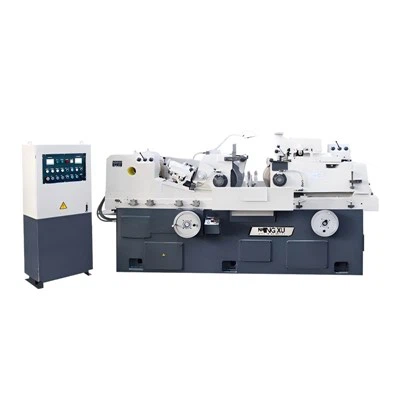
At the end of the day, the servo system isn’t just a component in your surface grinder—it’s the brain that makes precision grinding possible. It’s the reason you can get a surface that’s smooth to the touch, flat within a human hair, and consistent enough for a million parts to be identical. If you’re tired of scrap parts, long setup times, or having to hand-finish work that should be perfect, it might be time to take a closer look at the servo system powering your grinder. We’ve helped dozens of shops upgrade their servo systems and grinders, and the difference in their output and profitability is night and day. If you want to chat more about how the right servo system can level up your surface grinding operations, reach out to our team. We’d be happy to walk through your specific applications, answer any questions, and help you find a setup that fits your needs.
Hydraulic Surface Grinder References:
- Bolton, W. (2015). Mechatronics: Electronic Control Systems in Mechanical and Electrical Engineering. Pearson Education.
- Garvey, J. (2020). Precision Grinding Technology: Fundamentals and Applications. Industrial Press.
- Krasnov, A. (2018). Servo Systems for Manufacturing Automation. Springer.
- ISO 14638:2015, Geometrical product specifications (GPS) – Matrix model for geometrical specification and verification. International Organization for Standardization.
Wuxi Mingxu Machinery Equipment Co., Ltd.
As one of the most professional precision surface grinder manufacturers and suppliers in China, we’re featured by quality products and good price. Please rest assured to buy the best precision surface grinder for sale here from our factory. Also, custom service is available.
Address: No. 5-5 Jinke Wealth Plaza, Changjiang North Road, Xinwu District, Wuxi City, Jiangsu Province
E-mail: yingyingmxjd@163.com
WebSite: https://www.mingxu-china.com/
